Normative values for near point of convergence among university students in Oman
Medical hypothesis, discovery & innovation in optometry,
Vol. 6 No. 4 (2025),
30 January 2026
,
Page 174-180
https://doi.org/10.51329/mehdioptometry237
Abstract
Background: Near point of convergence (NPC) is a key clinical measure used in the assessment of binocular vision function and the diagnosis of convergence insufficiency. Normative NPC values vary across populations and are influenced by demographic and methodological factors. However, population-specific normative data for NPC are lacking in Oman. This study aimed to establish normative NPC break and recovery values among emmetropic university students in Oman and to examine variations by sex and age.Methods: This prospective cross-sectional study was conducted among students at the University of Buraimi, Oman. Emmetropic participants aged 17–25 with best-corrected distance visual acuity 20/20 or better, near visual acuity N6, normal binocular vision, and a Convergence Insufficiency Symptom Survey (CISS) score less than or equal to 21 were included. NPC break and recovery points were measured subjectively using a standardized Royal Air Force (RAF) ruler with an accommodative target. Three consecutive measurements were obtained for each parameter, and mean values were recorded. Descriptive statistics were calculated, and comparisons by sex and age group were performed using independent-samples t-tests and one-way analysis of variance, respectively.
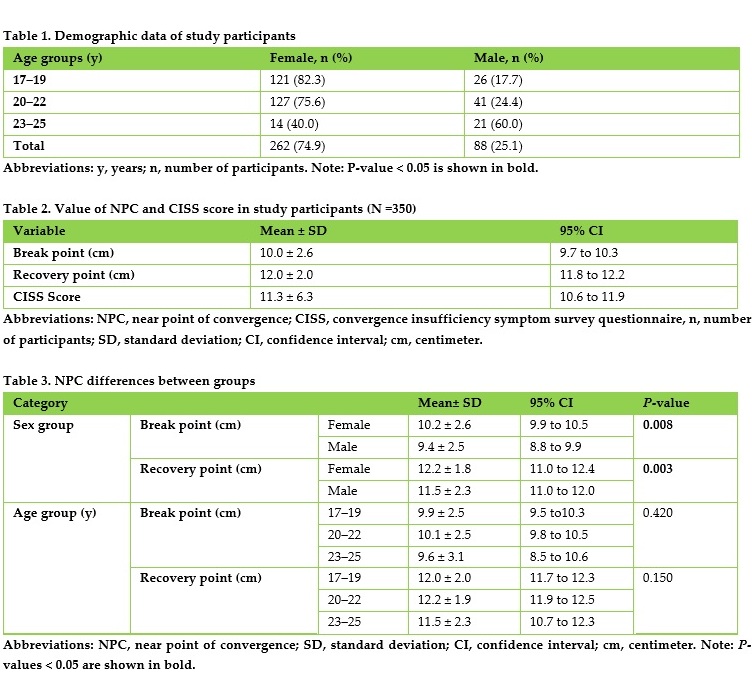
Results: A total of 350 participants (74.9% female) met the inclusion criteria, with a mean (standard deviation [SD]) age of 20.16 (1.78) years. The overall mean (SD) NPC break point was 10.0 (2.6) cm (95% confidence interval [CI]: 9.7–10.3 cm) and the mean (SD) recovery point was 12.0 (2.0) cm (95% CI: 11.8–12.2 cm). Mean (SD) CISS score was 11.3 (6.3) (95% CI: 10.6–11.9), indicating a largely asymptomatic cohort. Females showed significantly more remote NPC break and recovery points than males (break: 10.2 vs 9.4 cm, P < 0.05; recovery: 12.2 vs 11.5 cm, P < 0.05). No statistically significant differences in NPC break or recovery values were observed across age groups (17–19, 20–22, and 23–25 years; P > 0.05).
Conclusions: This study provides the first population-specific normative NPC break and recovery values for young adults in Oman using a standardized RAF ruler method. NPC measurements were influenced by sex but not by age within the examined range, reflecting the relative stability of convergence function in young adulthood. These findings offer clinically relevant reference values for optometric practice in Oman, underscoring the importance of establishing population- and context-specific normative data to enhance the assessment and management of binocular vision disorders.
Keywords:
- normative values
- near point of convergence
- university students
- RAF ruler
- near point convergence
- binocular vision
- ocular convergence
- optometry
- ophthalmology
References
1. O'Connor PJ. Normative data: their definition, interpretation, and importance for primary care physicians. Fam Med. 1990 Jul-Aug;22(4):307-11. PMID: 2200734.
2. Siderov J, Chiu SC, Waugh SJ. Differences in the nearpoint of convergence with target type. Ophthalmic Physiol Opt. 2001 Sep;21(5):356-60. doi: 10.1046/j.1475-1313.2001.00609.x. PMID: 11563422.
3. Mestre C, Bedell HE, Díaz-Doutón F, Pujol J, Gautier J. Characteristics of saccades during the near point of convergence test. Vision Res. 2021 Oct;187:27-40. doi: 10.1016/j.visres.2021.06.001. Epub 2021 Jun 17. PMID: 34147850.
4. Maia FCZE, Ramos BF, Bittar RSM, Cal RVR, Luís LA, Albernaz PLM. The Near Point of Convergence in Patients with Vestibular Migraine. Int Arch Otorhinolaryngol. 2025 Feb 5;29(1):1-4. doi: 10.1055/s-0044-1791643. PMID: 39911940; PMCID: PMC11798653.
5. Pang Y, Gabriel H, Frantz KA, Saeed F. A prospective study of different test targets for the near point of convergence. Ophthalmic Physiol Opt. 2010 May;30(3):298-303. doi: 10.1111/j.1475-1313.2010.00731.x. PMID: 20444137.
6. Hamed MM, David AG, Marzieh E. The relationship between binocular vision symptoms and near point of convergence. Indian J Ophthalmol. 2013 Jul;61(7):325-8. doi: 10.4103/0301-4738.97553. PMID: 23552348; PMCID: PMC3759101.
7. Ostadimoghaddam H, Hashemi H, Nabovati P, Yekta A, Khabazkhoob M. The distribution of near point of convergence and its association with age, gender and refractive error: a population-based study. Clin Exp Optom. 2017 May;100(3):255-259. doi: 10.1111/cxo.12471. Epub 2016 Sep 22. PMID: 27652584.
8. Hashemi H, Pakzad R, Yekta A, Asharlous A, Aghamirsalim M, Ostadimoghaddam H, Valadkhan M, Khabazkhoob M. The distribution of near point of convergence in an Iranian rural population: A population-based cross-sectional study. Saudi J Ophthalmol. 2019 Apr-Jun;33(2):148-152. doi: 10.1016/j.sjopt.2019.02.009. Epub 2019 May 4. PMID: 31384157; PMCID: PMC6664311.
9. Baskaran AA, Britto T, Sowndher RT, Thomas PA. Agreement between three methods for measuring near point of convergence among patients with different refractive errors. Saudi J Ophthalmol. 2021 Sep 9;35(1):15-20. doi: 10.4103/1319-4534.325776. PMID: 34667927; PMCID: PMC8486030.
10. Hayes GJ, Cohen BE, Rouse MW, De Land PN. Normative values for the nearpoint of convergence of elementary schoolchildren. Optom Vis Sci. 1998 Jul;75(7):506-12. doi: 10.1097/00006324-199807000-00019. PMID: 9703039.
11. Hashemi H, Nabovati P, Khabazkhoob M, Yekta A, Emamian MH, Fotouhi A. Near Point of Convergence in Iranian Schoolchildren: Normative Values and Associated Factors. Strabismus. 2018 Sep;26(3):126-132. doi: 10.1080/09273972.2018.1475493. Epub 2018 May 18. PMID: 29775110.
12. Hashemi H, Pakbin M, Ali B, Yekta A, Ostadimoghaddam H, Asharlous A, Aghamirsalim M, Khabazkhoob M. Near Points of Convergence and Accommodation in a Population of University Students in Iran. J Ophthalmic Vis Res. 2019 Jul 18;14(3):306-314. doi: 10.18502/jovr.v14i3.4787. PMID: 31660110; PMCID: PMC6815340.
13. Abraham NG, Srinivasan K, Thomas J. Normative data for near point of convergence, accommodation, and phoria. Oman J Ophthalmol. 2015 Jan-Apr;8(1):14-8. doi: 10.4103/0974-620X.149856. PMID: 25709268; PMCID: PMC4333536.
14. Ueda Y, Komiya A. Cultural adaptation of visual attention: calibration of the oculomotor control system in accordance with cultural scenes. PLoS One. 2012;7(11):e50282. doi: 10.1371/journal.pone.0050282. Epub 2012 Nov 19. PMID: 23185596; PMCID: PMC3501458.
15. Biswas S, El Kareh A, Qureshi M, Lee DMX, Sun CH, Lam JSH, Saw SM, Najjar RP. The influence of the environment and lifestyle on myopia. J Physiol Anthropol. 2024 Jan 31;43(1):7. doi: 10.1186/s40101-024-00354-7. PMID: 38297353; PMCID: PMC10829372.
16. Serre K, Sasongko MB. Modifiable lifestyle and environmental risk factors affecting the retinal microcirculation. Microcirculation. 2012 Jan;19(1):29-36. doi: 10.1111/j.1549-8719.2011.00121.x. PMID: 21740476.
17. Borsting EJ, Rouse MW, Mitchell GL, Scheiman M, Cotter SA, Cooper J, Kulp MT, London R; Convergence Insufficiency Treatment Trial Group. Validity and reliability of the revised convergence insufficiency symptom survey in children aged 9 to 18 years. Optom Vis Sci. 2003 Dec;80(12):832-8. doi: 10.1097/00006324-200312000-00014. PMID: 14688547.
18. Sathyanarayana ST, Mohanasundaram, Pushpa BV, Hema Harsha. Selecting the Right Sample Size: Methods and Considerations for Social Science Researchers. 2024 July. International Journal of Business and Management Invention (IJBMI). 13(7):152-167. doi: 10.35629/8028-1307152167.
19. Adler PM, Cregg M, Viollier AJ, Margaret Woodhouse J. Influence of target type and RAF rule on the measurement of near point of convergence. Ophthalmic Physiol Opt. 2007 Jan;27(1):22-30. doi: 10.1111/j.1475-1313.2006.00418.x. PMID: 17239187.
20. Bhowmick A, Kumar PP, Ratra D. Frequency of Non-strabismic Binocular Vision Anomalies among Optometrists in a Tertiary Eye Care Center in Southern India. Indian J Occup Environ Med. 2024 Apr-Jun;28(2):138-142. doi: 10.4103/ijoem.ijoem_243_23. Epub 2024 Jun 28. PMID: 39114096; PMCID: PMC11302529.
21. Chhetri S, Poudel R, Adhikari S, Belbase U, Cantó-Cerdán M, Poudel M, Thapa S. Prevalence and clinical profile of non-strabismic binocular vision anomalies in the Nepalese population: A hospital-based study. J Optom. 2025 Oct-Dec;18(4):100575. doi: 10.1016/j.optom.2025.100575. Epub 2025 Aug 8. PMID: 40782706; PMCID: PMC12355990.
22. Hashemi H, Nabovati P, Jamali A, Pakbin M, Yekta A, Aghamirsalim M, Asadollahi M, Khabazkhoob M. The distribution of the near point of convergence and its related factors in an elderly population: the Tehran Geriatric Eye Study (TGES). Eye (Lond). 2021 Dec;35(12):3404-3409. doi: 10.1038/s41433-021-01428-x. Epub 2021 Feb 19. PMID: 33608642; PMCID: PMC8602713.
23. Gavin N, Hepworth LR, Rowe FJ. Developing age-reference values for convergence and visual attention assessments. Strabismus. 2025 Nov 5:1-9. doi: 10.1080/09273972.2025.2581092. Epub ahead of print. PMID: 41194521.
24. Alnawmasi MM. The impact of convergence insufficiency on selective visual attention among university students. PLoS One. 2025 Nov 25;20(11):e0336715. doi: 10.1371/journal.pone.0336715. PMID: 41289276; PMCID: PMC12646433.
25. Garaszczuk IK, Jenczewska W, Asejczyk M. Superior monocular visual function but compromised binocular balance in precision shooters compared to age and refraction matched controls. Sci Rep. 2025 Aug 6;15(1):28816. doi: 10.1038/s41598-025-14497-9. PMID: 40770252; PMCID: PMC12328596.
26. Barata MJ, Aguiar P, Grzybowski A, Moreira-Rosário A, Lança C. A Review of Digital Eye Strain: Binocular Vision Anomalies, Ocular Surface Changes, and the Need for Objective Assessment. J Eye Mov Res. 2025 Sep 5;18(5):39. doi: 10.3390/jemr18050039. PMID: 40989226; PMCID: PMC12452390.
27. Darko-Takyi C, Mills TW, Boadi-Kusi SB, Ntodie M, Abraham CH, Abu EK, Amewuzah S, Essien E, Wiafe BO, Ocansey S. Association between near visual display device usage and the eye's accommodation and vergence parameters: a cross-sectional study of high school children in Cape Coast, Ghana. BMJ Public Health. 2025 Oct 17;3(2):e003041. doi: 10.1136/bmjph-2025-003041. PMID: 41133250; PMCID: PMC12542713.
28. Jiménez R, Pérez MA, García JA, González MD. Statistical normal values of visual parameters that characterize binocular function in children. Ophthalmic Physiol Opt. 2004 Nov;24(6):528-42. doi: 10.1111/j.1475-1313.2004.00234.x. PMID: 15491481.
29. Hashemi H, Pakbin M, Ali B, Yekta A, Ostadimoghaddam H, Asharlous A, Aghamirsalim M, Khabazkhoob M. Near Points of Convergence and Accommodation in a Population of University Students in Iran. J Ophthalmic Vis Res. 2019 Jul 18;14(3):306-314. doi: 10.18502/jovr.v14i3.4787. PMID: 31660110; PMCID: PMC6815340.
2. Siderov J, Chiu SC, Waugh SJ. Differences in the nearpoint of convergence with target type. Ophthalmic Physiol Opt. 2001 Sep;21(5):356-60. doi: 10.1046/j.1475-1313.2001.00609.x. PMID: 11563422.
3. Mestre C, Bedell HE, Díaz-Doutón F, Pujol J, Gautier J. Characteristics of saccades during the near point of convergence test. Vision Res. 2021 Oct;187:27-40. doi: 10.1016/j.visres.2021.06.001. Epub 2021 Jun 17. PMID: 34147850.
4. Maia FCZE, Ramos BF, Bittar RSM, Cal RVR, Luís LA, Albernaz PLM. The Near Point of Convergence in Patients with Vestibular Migraine. Int Arch Otorhinolaryngol. 2025 Feb 5;29(1):1-4. doi: 10.1055/s-0044-1791643. PMID: 39911940; PMCID: PMC11798653.
5. Pang Y, Gabriel H, Frantz KA, Saeed F. A prospective study of different test targets for the near point of convergence. Ophthalmic Physiol Opt. 2010 May;30(3):298-303. doi: 10.1111/j.1475-1313.2010.00731.x. PMID: 20444137.
6. Hamed MM, David AG, Marzieh E. The relationship between binocular vision symptoms and near point of convergence. Indian J Ophthalmol. 2013 Jul;61(7):325-8. doi: 10.4103/0301-4738.97553. PMID: 23552348; PMCID: PMC3759101.
7. Ostadimoghaddam H, Hashemi H, Nabovati P, Yekta A, Khabazkhoob M. The distribution of near point of convergence and its association with age, gender and refractive error: a population-based study. Clin Exp Optom. 2017 May;100(3):255-259. doi: 10.1111/cxo.12471. Epub 2016 Sep 22. PMID: 27652584.
8. Hashemi H, Pakzad R, Yekta A, Asharlous A, Aghamirsalim M, Ostadimoghaddam H, Valadkhan M, Khabazkhoob M. The distribution of near point of convergence in an Iranian rural population: A population-based cross-sectional study. Saudi J Ophthalmol. 2019 Apr-Jun;33(2):148-152. doi: 10.1016/j.sjopt.2019.02.009. Epub 2019 May 4. PMID: 31384157; PMCID: PMC6664311.
9. Baskaran AA, Britto T, Sowndher RT, Thomas PA. Agreement between three methods for measuring near point of convergence among patients with different refractive errors. Saudi J Ophthalmol. 2021 Sep 9;35(1):15-20. doi: 10.4103/1319-4534.325776. PMID: 34667927; PMCID: PMC8486030.
10. Hayes GJ, Cohen BE, Rouse MW, De Land PN. Normative values for the nearpoint of convergence of elementary schoolchildren. Optom Vis Sci. 1998 Jul;75(7):506-12. doi: 10.1097/00006324-199807000-00019. PMID: 9703039.
11. Hashemi H, Nabovati P, Khabazkhoob M, Yekta A, Emamian MH, Fotouhi A. Near Point of Convergence in Iranian Schoolchildren: Normative Values and Associated Factors. Strabismus. 2018 Sep;26(3):126-132. doi: 10.1080/09273972.2018.1475493. Epub 2018 May 18. PMID: 29775110.
12. Hashemi H, Pakbin M, Ali B, Yekta A, Ostadimoghaddam H, Asharlous A, Aghamirsalim M, Khabazkhoob M. Near Points of Convergence and Accommodation in a Population of University Students in Iran. J Ophthalmic Vis Res. 2019 Jul 18;14(3):306-314. doi: 10.18502/jovr.v14i3.4787. PMID: 31660110; PMCID: PMC6815340.
13. Abraham NG, Srinivasan K, Thomas J. Normative data for near point of convergence, accommodation, and phoria. Oman J Ophthalmol. 2015 Jan-Apr;8(1):14-8. doi: 10.4103/0974-620X.149856. PMID: 25709268; PMCID: PMC4333536.
14. Ueda Y, Komiya A. Cultural adaptation of visual attention: calibration of the oculomotor control system in accordance with cultural scenes. PLoS One. 2012;7(11):e50282. doi: 10.1371/journal.pone.0050282. Epub 2012 Nov 19. PMID: 23185596; PMCID: PMC3501458.
15. Biswas S, El Kareh A, Qureshi M, Lee DMX, Sun CH, Lam JSH, Saw SM, Najjar RP. The influence of the environment and lifestyle on myopia. J Physiol Anthropol. 2024 Jan 31;43(1):7. doi: 10.1186/s40101-024-00354-7. PMID: 38297353; PMCID: PMC10829372.
16. Serre K, Sasongko MB. Modifiable lifestyle and environmental risk factors affecting the retinal microcirculation. Microcirculation. 2012 Jan;19(1):29-36. doi: 10.1111/j.1549-8719.2011.00121.x. PMID: 21740476.
17. Borsting EJ, Rouse MW, Mitchell GL, Scheiman M, Cotter SA, Cooper J, Kulp MT, London R; Convergence Insufficiency Treatment Trial Group. Validity and reliability of the revised convergence insufficiency symptom survey in children aged 9 to 18 years. Optom Vis Sci. 2003 Dec;80(12):832-8. doi: 10.1097/00006324-200312000-00014. PMID: 14688547.
18. Sathyanarayana ST, Mohanasundaram, Pushpa BV, Hema Harsha. Selecting the Right Sample Size: Methods and Considerations for Social Science Researchers. 2024 July. International Journal of Business and Management Invention (IJBMI). 13(7):152-167. doi: 10.35629/8028-1307152167.
19. Adler PM, Cregg M, Viollier AJ, Margaret Woodhouse J. Influence of target type and RAF rule on the measurement of near point of convergence. Ophthalmic Physiol Opt. 2007 Jan;27(1):22-30. doi: 10.1111/j.1475-1313.2006.00418.x. PMID: 17239187.
20. Bhowmick A, Kumar PP, Ratra D. Frequency of Non-strabismic Binocular Vision Anomalies among Optometrists in a Tertiary Eye Care Center in Southern India. Indian J Occup Environ Med. 2024 Apr-Jun;28(2):138-142. doi: 10.4103/ijoem.ijoem_243_23. Epub 2024 Jun 28. PMID: 39114096; PMCID: PMC11302529.
21. Chhetri S, Poudel R, Adhikari S, Belbase U, Cantó-Cerdán M, Poudel M, Thapa S. Prevalence and clinical profile of non-strabismic binocular vision anomalies in the Nepalese population: A hospital-based study. J Optom. 2025 Oct-Dec;18(4):100575. doi: 10.1016/j.optom.2025.100575. Epub 2025 Aug 8. PMID: 40782706; PMCID: PMC12355990.
22. Hashemi H, Nabovati P, Jamali A, Pakbin M, Yekta A, Aghamirsalim M, Asadollahi M, Khabazkhoob M. The distribution of the near point of convergence and its related factors in an elderly population: the Tehran Geriatric Eye Study (TGES). Eye (Lond). 2021 Dec;35(12):3404-3409. doi: 10.1038/s41433-021-01428-x. Epub 2021 Feb 19. PMID: 33608642; PMCID: PMC8602713.
23. Gavin N, Hepworth LR, Rowe FJ. Developing age-reference values for convergence and visual attention assessments. Strabismus. 2025 Nov 5:1-9. doi: 10.1080/09273972.2025.2581092. Epub ahead of print. PMID: 41194521.
24. Alnawmasi MM. The impact of convergence insufficiency on selective visual attention among university students. PLoS One. 2025 Nov 25;20(11):e0336715. doi: 10.1371/journal.pone.0336715. PMID: 41289276; PMCID: PMC12646433.
25. Garaszczuk IK, Jenczewska W, Asejczyk M. Superior monocular visual function but compromised binocular balance in precision shooters compared to age and refraction matched controls. Sci Rep. 2025 Aug 6;15(1):28816. doi: 10.1038/s41598-025-14497-9. PMID: 40770252; PMCID: PMC12328596.
26. Barata MJ, Aguiar P, Grzybowski A, Moreira-Rosário A, Lança C. A Review of Digital Eye Strain: Binocular Vision Anomalies, Ocular Surface Changes, and the Need for Objective Assessment. J Eye Mov Res. 2025 Sep 5;18(5):39. doi: 10.3390/jemr18050039. PMID: 40989226; PMCID: PMC12452390.
27. Darko-Takyi C, Mills TW, Boadi-Kusi SB, Ntodie M, Abraham CH, Abu EK, Amewuzah S, Essien E, Wiafe BO, Ocansey S. Association between near visual display device usage and the eye's accommodation and vergence parameters: a cross-sectional study of high school children in Cape Coast, Ghana. BMJ Public Health. 2025 Oct 17;3(2):e003041. doi: 10.1136/bmjph-2025-003041. PMID: 41133250; PMCID: PMC12542713.
28. Jiménez R, Pérez MA, García JA, González MD. Statistical normal values of visual parameters that characterize binocular function in children. Ophthalmic Physiol Opt. 2004 Nov;24(6):528-42. doi: 10.1111/j.1475-1313.2004.00234.x. PMID: 15491481.
29. Hashemi H, Pakbin M, Ali B, Yekta A, Ostadimoghaddam H, Asharlous A, Aghamirsalim M, Khabazkhoob M. Near Points of Convergence and Accommodation in a Population of University Students in Iran. J Ophthalmic Vis Res. 2019 Jul 18;14(3):306-314. doi: 10.18502/jovr.v14i3.4787. PMID: 31660110; PMCID: PMC6815340.
- Abstract Viewed: 0 times
- Full Text PDF Downloaded: 0 times