Periorbital botulinum toxin injection and lacrimal gland position
Medical hypothesis, discovery & innovation in optometry,
Vol. 7 No. 2 (2026),
24 July 2026
,
Page 73-79
https://doi.org/10.51329/mehdioptometry248
Abstract
Background: Botulinum toxin injection is the most widely performed nonsurgical procedure for upper facial rejuvenation and has an established safety profile. Because the lacrimal gland is anatomically supported by the surrounding periocular soft tissues, temporary muscle relaxation following periorbital botulinum toxin injection may alter the gland’s configuration or spatial relationship within the lacrimal fossa. This prospective pilot study evaluated changes in ultrasonographically measured lacrimal gland dimensions following cosmetic periorbital botulinum toxin injection.Methods: This prospective pilot study enrolled eligible adults undergoing cosmetic periorbital botulinum toxin type A injection at a tertiary ophthalmic center between January 2022 and September 2024. Participants underwent standardized ophthalmic and periorbital examinations before treatment. Lacrimal gland ultrasonography was performed at baseline and two weeks after injection by a blinded radiologist in both the supine and sitting positions. Maximum axial and anteroposterior dimensions of both lacrimal glands were measured bilaterally. These measurements represented ultrasonographic gland dimensions and did not directly quantify three-dimensional displacement or anatomical position. Changes from baseline, group comparisons, and associations with demographic and clinical characteristics were evaluated.
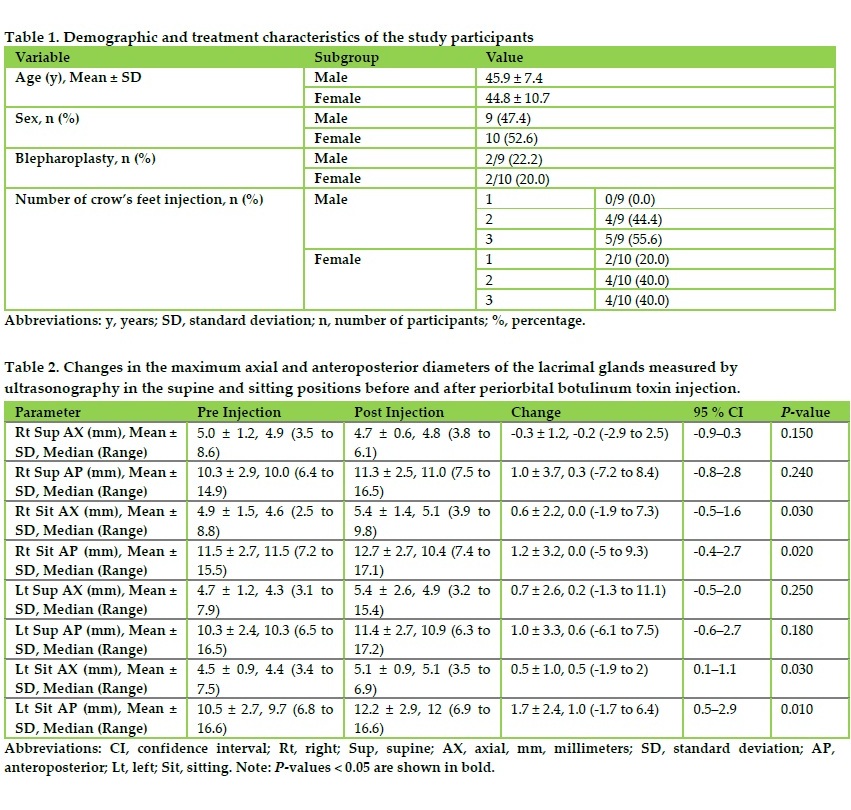
Results: Nineteen participants were included (10 [52.6%] women and 9 [47.4%] men; mean [standard deviation] age, 45.3 [9.0] years). Compared with baseline, lacrimal gland dimensions generally increased after periorbital botulinum toxin injection, except for a small, non-significant decrease in the axial diameter of the right lacrimal gland in the supine position (P > 0.05). Statistically significant increases in the axial and anteroposterior dimensions of both lacrimal glands were observed in the sitting position (all P < 0.05), with no statistically significant changes detected in the supine position (all P > 0.05). Changes in ultrasound parameters were not significantly associated with age, sex, previous upper-eyelid blepharoplasty, or number of crow’s feet injection points (all P greater than or equal to 0.05).
Conclusions: This prospective pilot study showed that cosmetic periorbital botulinum toxin injection was associated with changes in ultrasonographically measured lacrimal gland dimensions, particularly in the sitting position. Although gland position was not directly quantified, these dimensional changes may indirectly reflect alterations in gland configuration or its spatial relationship with the surrounding periocular structures following temporary muscular relaxation. Larger prospective studies with longer follow-up, comprehensive functional assessments, and imaging methods that directly assess anatomical displacement are warranted to verify these preliminary findings and clarify their clinical significance.
Keywords:
- clostridium botulinum toxins
- botulinum toxin
- skin wrinkling
- lacrimal gland
- medical sonography
- ultrasonic imaging
- supine positions
- sitting positions
- age factor
References
1. Qaqish C. Botulinum Toxin Use in the Upper Face. Atlas Oral Maxillofac Surg Clin North Am. 2016 Sep;24(2):95-103. doi: 10.1016/j.cxom.2016.05.006. PMID: 27499468.
2. Safia A, Elhadi UA, Merchavy S, Batheesh R, Bathish N. Cosmetic Botulinum Toxin A Injections to the Upper Face: A Systematic Review and Meta-Analysis of Clinical Studies. J Cosmet Dermatol. 2026 Jan;25(1):e70655. doi: 10.1111/jocd.70655. PMID: 41508559; PMCID: PMC12783872.
3. Sundaram H, Signorini M, Liew S, Trindade de Almeida AR, Wu Y, Vieira Braz A, Fagien S, Goodman GJ, Monheit G, Raspaldo H; Global Aesthetics Consensus Group. Global Aesthetics Consensus: Botulinum Toxin Type A--Evidence-Based Review, Emerging Concepts, and Consensus Recommendations for Aesthetic Use, Including Updates on Complications. Plast Reconstr Surg. 2016 Mar;137(3):518e-529e. doi: 10.1097/01.prs.0000475758.63709.23. PMID: 26910696; PMCID: PMC5242214.
4. Kassir M, Gupta M, Galadari H, Kroumpouzos G, Katsambas A, Lotti T, Vojvodic A, Grabbe S, Juchems E, Goldust M. Complications of botulinum toxin and fillers: A narrative review. J Cosmet Dermatol. 2020 Mar;19(3):570-573. doi: 10.1111/jocd.13266. Epub 2019 Dec 30. PMID: 31889407.
5. Burkat CN, Wei LA (2014). 'Anatomy of the lacrimal system’. In The Lacrimal System: Diagnosis, Management, and Surgery, Second Edition (pp. 1-14). Cham: Springer International Publishing. Print ISBN: 978-3-319-10331-0; Online ISBN: 978-3-319-10332-7; doi: 10.1007/978-3-319-10332-7_1.
6. Shin HJ, You JW, Koh KS, Song WC. Topography of the orbital part of the lacrimal gland for treating epiphora using botulinum toxin injection. Clin Anat. 2022 Oct;35(7):861-866. doi: 10.1002/ca.23870. Epub 2022 Apr 16. PMID: 35384059.
7. Machiele R, Lopez MJ, Czyz CN. Anatomy, Head and Neck: Eye Lacrimal Gland. 2023 Jul 24. In: StatPearls [Internet]. Treasure Island (FL): StatPearls Publishing; 2026 Jan–. PMID: 30422509.
8. De Lucia O, Zandonella Callegher S, De Souza MV, Battafarano N, Del Papa N, Gerosa M, Giovannini I, Tullio A, Valent F, Zabotti A, Caporali R, De Vita S. Ultrasound assessment of lacrimal glands: a cross-sectional study in healthy subjects and a preliminary study in primary Sjögren's syndrome patients. Clin Exp Rheumatol. 2020 Jul-Aug;38 Suppl 126(4):203-209. Epub 2020 Oct 23. PMID: 33095143.
9. Kim SH, Min HK, Lee SH, Lee KA, Kim HR. Ultrasonographic evaluation of lacrimal glands in patients with primary Sjögren's syndrome. Clin Exp Rheumatol. 2022 Dec;40(12):2283-2289. doi: 10.55563/clinexprheumatol/em2xlu. Epub 2022 Sep 6. PMID: 36067215.
10. Fana V, Terslev L. Lacrimal and salivary gland ultrasound - how and when to use in patients with primary Sjögren's syndrome. Best Pract Res Clin Rheumatol. 2023 Mar;37(1):101837. doi: 10.1016/j.berh.2023.101837. Epub 2023 May 29. PMID: 37258318.
11. Kashkouli MB, Tabrizi A, Ghazizadeh M, Khademi B, Karimi N. Supine Test: A New Test for Detecting Lacrimal Gland Prolapse Before Upper Blepharoplasty. Ophthalmic Plast Reconstr Surg. 2019 Nov/Dec;35(6):581-585. doi: 10.1097/IOP.0000000000001397. PMID: 31116144.
12. Jaspers GW, Pijpe J, Jansma J. The use of botulinum toxin type A in cosmetic facial procedures. Int J Oral Maxillofac Surg. 2011 Feb;40(2):127-33. doi: 10.1016/j.ijom.2010.09.014. Epub 2010 Oct 20. PMID: 20965695.
13. Singh S, Basu S. The Human Lacrimal Gland: Historical Perspectives, Current Understanding, and Recent Advances. Curr Eye Res. 2020 Oct;45(10):1188-1198. doi: 10.1080/02713683.2020.1774065. Epub 2020 Jun 15. PMID: 32450044.
14. Ho RW, Fang PC, Chang CH, Liu YP, Kuo MT. A Review of Periocular Botulinum Neurotoxin on the Tear Film Homeostasis and the Ocular Surface Change. Toxins (Basel). 2019 Jan 24;11(2):66. doi: 10.3390/toxins11020066. PMID: 30678375; PMCID: PMC6409927.
15. Ho MC, Hsu WC, Hsieh YT. Botulinum toxin type a injection for lateral canthal rhytids : effect on tear film stability and tear production. JAMA Ophthalmol. 2014 Mar;132(3):332-7. doi: 10.1001/jamaophthalmol.2013.6243. PMID: 24385079.
16. Alharbi MM, Bin Dlaim MS, Alqahtani JM, Alkhudhairy NS, Almasoudi SM, Alajmi NT. Ophthalmic Complications of Periorbital and Facial Aesthetic Procedures: A Literature Review. Cureus. 2023 Jul 1;15(7):e41246. doi: 10.7759/cureus.41246. PMID: 37529817; PMCID: PMC10388289.
17. Matarasso SL. Decreased tear expression with an abnormal Schirmer's test following botulinum toxin type A for the treatment of lateral canthal rhytides. Dermatol Surg. 2002 Feb;28(2):149-52. doi: 10.1046/j.1524-4725.2002.01149.x. PMID: 11860426.
18. Massry GG. Prevalence of lacrimal gland prolapse in the functional blepharoplasty population. Ophthalmic Plast Reconstr Surg. 2011 Nov-Dec;27(6):410-3. doi: 10.1097/IOP.0b013e31821d852e. PMID: 21659918.
19. Kashkouli MB, Abdolalizadeh P, Abolfathzadeh N, Sianati H, Sharepour M, Hadi Y. Periorbital facial rejuvenation; applied anatomy and pre-operative assessment. J Curr Ophthalmol. 2017 Apr 25;29(3):154-168. doi: 10.1016/j.joco.2017.04.001. Erratum in: J Curr Ophthalmol. 2018 Mar 06;30(2):188-189. doi: 10.1016/j.joco.2017.11.013. PMID: 28913505; PMCID: PMC5587258.
20. Eshraghi B, Najafi M, Babaei L, Moradi M, Aghajani A. Diagnosis and Treatment of Lacrimal Gland Prolapse: A Narrative Review. Aesthetic Plast Surg. 2024 Aug;48(15):2786-2792. doi: 10.1007/s00266-024-04017-x. Epub 2024 May 13. PMID: 38740621.
21. Bai JS, Song MJ, Li BT, Tian R. Timing of Surgery and Treatment Options for Congenital Ptosis in Children: A Narrative Review of the Literature. Aesthetic Plast Surg. 2023 Feb;47(1):226-234. doi: 10.1007/s00266-022-03039-7. Epub 2022 Sep 16. PMID: 36114384.
22. Kulkarni AR, Aggarwal SP, Kulkarni RR, Deshpande MD, Walimbe PB, Labhsetwar AS. Ocular manifestations of head injury: a clinical study. Eye (Lond). 2005 Dec;19(12):1257-63. doi: 10.1038/sj.eye.6701753. PMID: 15543173.
23. Henares Chavarino ÁA, Estiragués Cerdá M, Ros Magallón A, Vicente Ruiz M, Arroyo Pérez Í, Bazán Álvarez A. Correction of Lacrimal Gland Ptosis in Blepharoplasty: A Systematic Review. Ophthalmic Plast Reconstr Surg. 2023 Sep-Oct 01;39(5):427-432. doi: 10.1097/IOP.0000000000002388. Epub 2023 Apr 3. PMID: 37010058.
24. Gao Y, Chang Q, Li Y, Zhang H, Hou Z, Zhang Z, Li Z, Li D. Correlation between extent of lacrimal gland prolapse and clinical features of thyroid-associated ophthalmopathy: a retrospective observational study. BMC Ophthalmol. 2022 Feb 10;22(1):66. doi: 10.1186/s12886-022-02270-9. PMID: 35144579; PMCID: PMC8832675.
25. Brodsky MA, Swope DM, Grimes D. Diffusion of botulinum toxins. Tremor Other Hyperkinet Mov (N Y). 2012;2:tre-02-85-417-1. doi: 10.7916/D88W3C1M. Epub 2012 Aug 6. PMID: 23440162; PMCID: PMC3570036.
26. Yi KH, Lee JH, Kim GY, Yoon SW, Oh W, Kim HJ. Novel Anatomical Proposal for Botulinum Neurotoxin Injection Targeting Lateral Canthal Rhytids. Toxins (Basel). 2022 Jul 6;14(7):462. doi: 10.3390/toxins14070462. PMID: 35878200; PMCID: PMC9316553.
27. Obata H. Anatomy and histopathology of the human lacrimal gland. Cornea. 2006 Dec;25(10 Suppl 1):S82-9. doi: 10.1097/01.ico.0000247220.18295.d3. PMID: 17001201.
28. Takahashi Y, Watanabe A, Matsuda H, Nakamura Y, Nakano T, Asamoto K, Ikeda H, Kakizaki H. Anatomy of secretory glands in the eyelid and conjunctiva: a photographic review. Ophthalmic Plast Reconstr Surg. 2013 May-Jun;29(3):215-9. doi: 10.1097/IOP.0b013e3182833dee. PMID: 23381567.
29. Mally P, Czyz CN, Wulc AE. The Role of Gravity in Periorbital and Midfacial Aging. Aesthet Surg J. 2014 Aug;34(6):809-22. doi: 10.1177/1090820X14535077. Epub 2014 Aug 1. PMID: 24879881.
2. Safia A, Elhadi UA, Merchavy S, Batheesh R, Bathish N. Cosmetic Botulinum Toxin A Injections to the Upper Face: A Systematic Review and Meta-Analysis of Clinical Studies. J Cosmet Dermatol. 2026 Jan;25(1):e70655. doi: 10.1111/jocd.70655. PMID: 41508559; PMCID: PMC12783872.
3. Sundaram H, Signorini M, Liew S, Trindade de Almeida AR, Wu Y, Vieira Braz A, Fagien S, Goodman GJ, Monheit G, Raspaldo H; Global Aesthetics Consensus Group. Global Aesthetics Consensus: Botulinum Toxin Type A--Evidence-Based Review, Emerging Concepts, and Consensus Recommendations for Aesthetic Use, Including Updates on Complications. Plast Reconstr Surg. 2016 Mar;137(3):518e-529e. doi: 10.1097/01.prs.0000475758.63709.23. PMID: 26910696; PMCID: PMC5242214.
4. Kassir M, Gupta M, Galadari H, Kroumpouzos G, Katsambas A, Lotti T, Vojvodic A, Grabbe S, Juchems E, Goldust M. Complications of botulinum toxin and fillers: A narrative review. J Cosmet Dermatol. 2020 Mar;19(3):570-573. doi: 10.1111/jocd.13266. Epub 2019 Dec 30. PMID: 31889407.
5. Burkat CN, Wei LA (2014). 'Anatomy of the lacrimal system’. In The Lacrimal System: Diagnosis, Management, and Surgery, Second Edition (pp. 1-14). Cham: Springer International Publishing. Print ISBN: 978-3-319-10331-0; Online ISBN: 978-3-319-10332-7; doi: 10.1007/978-3-319-10332-7_1.
6. Shin HJ, You JW, Koh KS, Song WC. Topography of the orbital part of the lacrimal gland for treating epiphora using botulinum toxin injection. Clin Anat. 2022 Oct;35(7):861-866. doi: 10.1002/ca.23870. Epub 2022 Apr 16. PMID: 35384059.
7. Machiele R, Lopez MJ, Czyz CN. Anatomy, Head and Neck: Eye Lacrimal Gland. 2023 Jul 24. In: StatPearls [Internet]. Treasure Island (FL): StatPearls Publishing; 2026 Jan–. PMID: 30422509.
8. De Lucia O, Zandonella Callegher S, De Souza MV, Battafarano N, Del Papa N, Gerosa M, Giovannini I, Tullio A, Valent F, Zabotti A, Caporali R, De Vita S. Ultrasound assessment of lacrimal glands: a cross-sectional study in healthy subjects and a preliminary study in primary Sjögren's syndrome patients. Clin Exp Rheumatol. 2020 Jul-Aug;38 Suppl 126(4):203-209. Epub 2020 Oct 23. PMID: 33095143.
9. Kim SH, Min HK, Lee SH, Lee KA, Kim HR. Ultrasonographic evaluation of lacrimal glands in patients with primary Sjögren's syndrome. Clin Exp Rheumatol. 2022 Dec;40(12):2283-2289. doi: 10.55563/clinexprheumatol/em2xlu. Epub 2022 Sep 6. PMID: 36067215.
10. Fana V, Terslev L. Lacrimal and salivary gland ultrasound - how and when to use in patients with primary Sjögren's syndrome. Best Pract Res Clin Rheumatol. 2023 Mar;37(1):101837. doi: 10.1016/j.berh.2023.101837. Epub 2023 May 29. PMID: 37258318.
11. Kashkouli MB, Tabrizi A, Ghazizadeh M, Khademi B, Karimi N. Supine Test: A New Test for Detecting Lacrimal Gland Prolapse Before Upper Blepharoplasty. Ophthalmic Plast Reconstr Surg. 2019 Nov/Dec;35(6):581-585. doi: 10.1097/IOP.0000000000001397. PMID: 31116144.
12. Jaspers GW, Pijpe J, Jansma J. The use of botulinum toxin type A in cosmetic facial procedures. Int J Oral Maxillofac Surg. 2011 Feb;40(2):127-33. doi: 10.1016/j.ijom.2010.09.014. Epub 2010 Oct 20. PMID: 20965695.
13. Singh S, Basu S. The Human Lacrimal Gland: Historical Perspectives, Current Understanding, and Recent Advances. Curr Eye Res. 2020 Oct;45(10):1188-1198. doi: 10.1080/02713683.2020.1774065. Epub 2020 Jun 15. PMID: 32450044.
14. Ho RW, Fang PC, Chang CH, Liu YP, Kuo MT. A Review of Periocular Botulinum Neurotoxin on the Tear Film Homeostasis and the Ocular Surface Change. Toxins (Basel). 2019 Jan 24;11(2):66. doi: 10.3390/toxins11020066. PMID: 30678375; PMCID: PMC6409927.
15. Ho MC, Hsu WC, Hsieh YT. Botulinum toxin type a injection for lateral canthal rhytids : effect on tear film stability and tear production. JAMA Ophthalmol. 2014 Mar;132(3):332-7. doi: 10.1001/jamaophthalmol.2013.6243. PMID: 24385079.
16. Alharbi MM, Bin Dlaim MS, Alqahtani JM, Alkhudhairy NS, Almasoudi SM, Alajmi NT. Ophthalmic Complications of Periorbital and Facial Aesthetic Procedures: A Literature Review. Cureus. 2023 Jul 1;15(7):e41246. doi: 10.7759/cureus.41246. PMID: 37529817; PMCID: PMC10388289.
17. Matarasso SL. Decreased tear expression with an abnormal Schirmer's test following botulinum toxin type A for the treatment of lateral canthal rhytides. Dermatol Surg. 2002 Feb;28(2):149-52. doi: 10.1046/j.1524-4725.2002.01149.x. PMID: 11860426.
18. Massry GG. Prevalence of lacrimal gland prolapse in the functional blepharoplasty population. Ophthalmic Plast Reconstr Surg. 2011 Nov-Dec;27(6):410-3. doi: 10.1097/IOP.0b013e31821d852e. PMID: 21659918.
19. Kashkouli MB, Abdolalizadeh P, Abolfathzadeh N, Sianati H, Sharepour M, Hadi Y. Periorbital facial rejuvenation; applied anatomy and pre-operative assessment. J Curr Ophthalmol. 2017 Apr 25;29(3):154-168. doi: 10.1016/j.joco.2017.04.001. Erratum in: J Curr Ophthalmol. 2018 Mar 06;30(2):188-189. doi: 10.1016/j.joco.2017.11.013. PMID: 28913505; PMCID: PMC5587258.
20. Eshraghi B, Najafi M, Babaei L, Moradi M, Aghajani A. Diagnosis and Treatment of Lacrimal Gland Prolapse: A Narrative Review. Aesthetic Plast Surg. 2024 Aug;48(15):2786-2792. doi: 10.1007/s00266-024-04017-x. Epub 2024 May 13. PMID: 38740621.
21. Bai JS, Song MJ, Li BT, Tian R. Timing of Surgery and Treatment Options for Congenital Ptosis in Children: A Narrative Review of the Literature. Aesthetic Plast Surg. 2023 Feb;47(1):226-234. doi: 10.1007/s00266-022-03039-7. Epub 2022 Sep 16. PMID: 36114384.
22. Kulkarni AR, Aggarwal SP, Kulkarni RR, Deshpande MD, Walimbe PB, Labhsetwar AS. Ocular manifestations of head injury: a clinical study. Eye (Lond). 2005 Dec;19(12):1257-63. doi: 10.1038/sj.eye.6701753. PMID: 15543173.
23. Henares Chavarino ÁA, Estiragués Cerdá M, Ros Magallón A, Vicente Ruiz M, Arroyo Pérez Í, Bazán Álvarez A. Correction of Lacrimal Gland Ptosis in Blepharoplasty: A Systematic Review. Ophthalmic Plast Reconstr Surg. 2023 Sep-Oct 01;39(5):427-432. doi: 10.1097/IOP.0000000000002388. Epub 2023 Apr 3. PMID: 37010058.
24. Gao Y, Chang Q, Li Y, Zhang H, Hou Z, Zhang Z, Li Z, Li D. Correlation between extent of lacrimal gland prolapse and clinical features of thyroid-associated ophthalmopathy: a retrospective observational study. BMC Ophthalmol. 2022 Feb 10;22(1):66. doi: 10.1186/s12886-022-02270-9. PMID: 35144579; PMCID: PMC8832675.
25. Brodsky MA, Swope DM, Grimes D. Diffusion of botulinum toxins. Tremor Other Hyperkinet Mov (N Y). 2012;2:tre-02-85-417-1. doi: 10.7916/D88W3C1M. Epub 2012 Aug 6. PMID: 23440162; PMCID: PMC3570036.
26. Yi KH, Lee JH, Kim GY, Yoon SW, Oh W, Kim HJ. Novel Anatomical Proposal for Botulinum Neurotoxin Injection Targeting Lateral Canthal Rhytids. Toxins (Basel). 2022 Jul 6;14(7):462. doi: 10.3390/toxins14070462. PMID: 35878200; PMCID: PMC9316553.
27. Obata H. Anatomy and histopathology of the human lacrimal gland. Cornea. 2006 Dec;25(10 Suppl 1):S82-9. doi: 10.1097/01.ico.0000247220.18295.d3. PMID: 17001201.
28. Takahashi Y, Watanabe A, Matsuda H, Nakamura Y, Nakano T, Asamoto K, Ikeda H, Kakizaki H. Anatomy of secretory glands in the eyelid and conjunctiva: a photographic review. Ophthalmic Plast Reconstr Surg. 2013 May-Jun;29(3):215-9. doi: 10.1097/IOP.0b013e3182833dee. PMID: 23381567.
29. Mally P, Czyz CN, Wulc AE. The Role of Gravity in Periorbital and Midfacial Aging. Aesthet Surg J. 2014 Aug;34(6):809-22. doi: 10.1177/1090820X14535077. Epub 2014 Aug 1. PMID: 24879881.
- Abstract Viewed: 0 times
- Full Text PDF Downloaded: 0 times