Impact of artificial tear formulation and timing on keratometric measurements in cataract patients with and without dry eye disease: a randomized cross-over study
Medical hypothesis, discovery & innovation in optometry,
Vol. 7 No. 1 (2026),
27 May 2026
,
Page 31-40
https://doi.org/10.51329/mehdioptometry243
Abstract
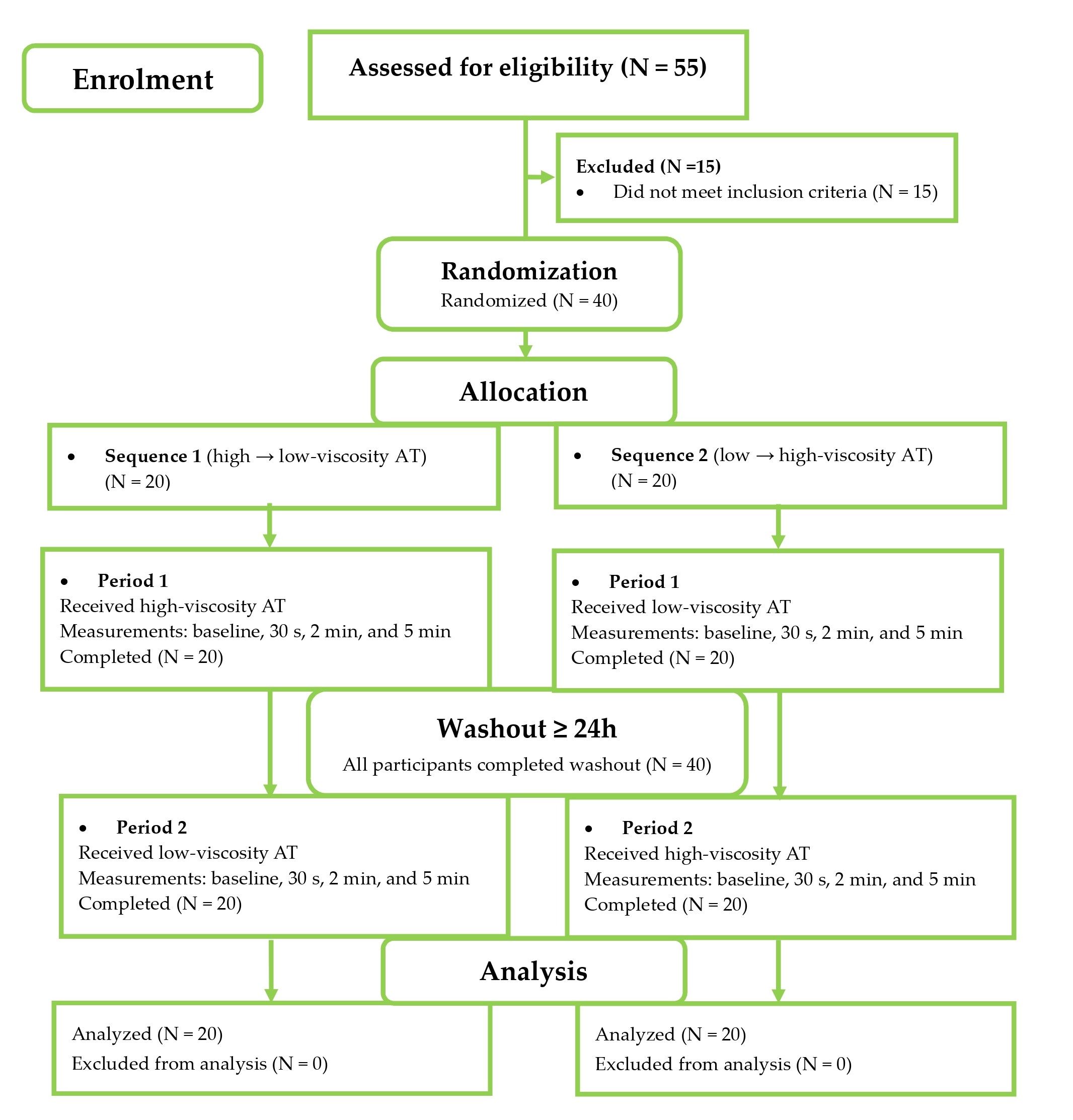
Background: Accurate keratometric assessment is essential for intraocular lens (IOL) power calculation in cataract surgery. Artificial tears are commonly used to optimize the ocular surface; however, their short-term effects on keratometric and biometric measurements remain uncertain. This study evaluated the impact of artificial tears with different viscosities on keratometry and optical biometry parameters in cataract patients with and without dry eye disease (DED).Methods: This prospective, randomized cross-over study included 40 cataract patients, comprising 20 with mild-to-moderate DED and 20 with normal ocular surfaces. Each participant received high- and low-viscosity artificial tears on separate visits in randomized order, with a 24-h washout period. Keratometric parameters (K1 and K2), axial length (AL), and anterior chamber depth (ACD) were measured at baseline and at 30 s, 2 min, and 5 min after drop instillation. Calculated IOL power was evaluated at baseline and 5 min.
Results: Participants with DED were significantly older than those with normal ocular surfaces (P < 0.05), whereas sex distribution and intraocular pressure were comparable between groups (both P > 0.05). Following artificial tear instillation, K1 and K2 measurements showed time-dependent descriptive changes across ocular-surface and formulation conditions. In both DED conditions, the lowest mean K1 value was observed at 30 s. In normal-eye conditions, mean K1 values were similar to baseline at 30 s and increased numerically toward 5 min. K2 measurements showed differing temporal patterns, with the largest numerical fluctuations observed in the DED/high-viscosity condition and smaller changes in the normal-eye/low-viscosity condition. Some descriptive differences remained evident at 5 min. AL and ACD measurements showed broadly similar distributions across conditions and timepoints. Calculated IOL power distributions at baseline and 5 min are presented for each study condition.
Conclusions: Artificial tear instillation was associated with short-term, time-dependent alterations in keratometric measurements, with differing descriptive patterns across ocular-surface and formulation conditions. These findings highlight the importance of timing in optical biometry and suggest that keratometric measurements obtained shortly after artificial tear instillation should be interpreted cautiously. Because some changes remained evident at the 5-min assessment, the optimal waiting interval cannot be determined from these data alone and requires further investigation.
- cross-over trials
- artificial tears
- viscosities
- biometric analysis
- topography
- corneal
- anterior chambers
- eye axial length
- intraocular lens implantation
- phakic intraocular lens
References
Sheard R. Optimising biometry for best outcomes in cataract surgery. Eye (Lond). 2014 Feb;28(2):118-25. doi: 10.1038/eye.2013.248. Epub 2013 Dec 6. PMID: 24310239; PMCID: PMC3930261.
Gupta V, Pal H, Sawhney S, Aggarwal A, Vanathi M, Luthra G. Optimization of biometry for best refractive outcome in cataract surgery. Indian J Ophthalmol. 2024 Jan 1;72(1):29-43. doi: 10.4103/IJO.IJO_1219_23. Epub 2023 Dec 22. PMID: 38131567; PMCID: PMC10841781.
DelMonte DW, Kim T. Anatomy and physiology of the cornea. J Cataract Refract Surg. 2011 Mar;37(3):588-98. doi: 10.1016/j.jcrs.2010.12.037. PMID: 21333881.
Meek KM, Knupp C. Corneal structure and transparency. Prog Retin Eye Res. 2015 Nov;49:1-16. doi: 10.1016/j.preteyeres.2015.07.001. Epub 2015 Jul 2. PMID: 26145225; PMCID: PMC4655862.
Khoramnia R, Auffarth G, ?abuz G, Pettit G, Suryakumar R. Refractive Outcomes after Cataract Surgery. Diagnostics (Basel). 2022 Jan 19;12(2):243. doi: 10.3390/diagnostics12020243. PMID: 35204334; PMCID: PMC8870878.
Craig JP, Nichols KK, Akpek EK, Caffery B, Dua HS, Joo CK, Liu Z, Nelson JD, Nichols JJ, Tsubota K, Stapleton F. TFOS DEWS II Definition and Classification Report. Ocul Surf. 2017 Jul;15(3):276-283. doi: 10.1016/j.jtos.2017.05.008. Epub 2017 Jul 20. PMID: 28736335.
Willcox MDP, Argüeso P, Georgiev GA, Holopainen JM, Laurie GW, Millar TJ, Papas EB, Rolland JP, Schmidt TA, Stahl U, Suarez T, Subbaraman LN, Uçakhan OÖ, Jones L. TFOS DEWS II Tear Film Report. Ocul Surf. 2017 Jul;15(3):366-403. doi: 10.1016/j.jtos.2017.03.006. Epub 2017 Jul 20. PMID: 28736338; PMCID: PMC6035753.
Noor NA, Rahayu T, Gondhowiardjo TD. Prevalence of Dry Eye and its Subtypes in an Elderly Population with Cataracts in Indonesia. Clin Ophthalmol. 2020 Jul 24;14:2143-2150. doi: 10.2147/OPTH.S240057. PMID: 32801623; PMCID: PMC7399451.
Yang F, Yang L, Ning X, Liu J, Wang J. Effect of dry eye on the reliability of keratometry for cataract surgery planning. J Fr Ophtalmol. 2024 Feb;47(2):103999. doi: 10.1016/j.jfo.2023.04.016. Epub 2023 Oct 31. PMID: 37919153.
Zhang X, Xiao K, Lai T, Zhang R, Huang M, Xue Y, Li L, Rao H. Reproducibility and accuracy of corneal curvature measurements in patients with and without dry eye: a device-based study. Front Med (Lausanne). 2025 May 16;12:1565740. doi: 10.3389/fmed.2025.1565740. PMID: 40454149; PMCID: PMC12122522.
Chen Y, Li M, Chen J, Zhao J, Pazo EE, Qin G, He X. To evaluate the effects of artificial tears on ocular biological parameters in dry eye and non-dry eye patients. Sci Rep. 2025 Apr 11;15(1):12392. doi: 10.1038/s41598-025-95801-5. PMID: 40216886; PMCID: PMC11992173.
Brignole F, Pisella PJ, Dupas B, Baeyens V, Baudouin C. Efficacy and safety of 0.18% sodium hyaluronate in patients with moderate dry eye syndrome and superficial keratitis. Graefes Arch Clin Exp Ophthalmol. 2005 Jun;243(6):531-8. doi: 10.1007/s00417-004-1040-6. Epub 2004 Dec 17. PMID: 15965673.
Lee Y, Kim TH, Paik HJ, Kim DH. Artificial Tear Instillation-Induced Changes in Corneal Topography. Bioengineering (Basel). 2024 Jan 26;11(2):121. doi: 10.3390/bioengineering11020121. PMID: 38391607; PMCID: PMC10886152.
Hovanesian J, Epitropoulos A, Donnenfeld ED, Holladay JT. The Effect of Lifitegrast on Refractive Accuracy and Symptoms in Dry Eye Patients Undergoing Cataract Surgery. Clin Ophthalmol. 2020 Sep 16;14:2709-2716. doi: 10.2147/OPTH.S264520. PMID: 32982163; PMCID: PMC7502384.
Röggla V, Leydolt C, Schartmüller D, Schwarzenbacher L, Meyer E, Abela-Formanek C, Menapace R. Influence of Artificial Tears on Keratometric Measurements in Cataract Patients. Am J Ophthalmol. 2021 Jan;221:1-8. doi: 10.1016/j.ajo.2020.08.024. Epub 2020 Aug 21. PMID: 32828877.
Koh S, Maeda N, Ikeda C, Takai Y, Fujimoto H, Oie Y, Soma T, Tsujikawa M, Nishida K. Effect of instillation of eyedrops for dry eye on optical quality. Invest Ophthalmol Vis Sci. 2013 Jul 26;54(7):4927-33. doi: 10.1167/iovs.13-12409. PMID: 23812492.
Pan African Clinical Trials Registry (2025). 'Influence of Artificial Tears on Keratometric Measurements in Cataract Patients' . Available at: https://pactr.samrc.ac.za/TrialDisplay.aspx?TrialID=41265 (Accessed: 01 February 2026)
Faul F, Erdfelder E, Buchner A, Lang AG. Statistical power analyses using G*Power 3.1: tests for correlation and regression analyses. Behav Res Methods. 2009 Nov;41(4):1149-60. doi: 10.3758/BRM.41.4.1149. PMID: 19897823.
Wolffsohn JS, Arita R, Chalmers R, Djalilian A, Dogru M, Dumbleton K, Gupta PK, Karpecki P, Lazreg S, Pult H, Sullivan BD, Tomlinson A, Tong L, Villani E, Yoon KC, Jones L, Craig JP. TFOS DEWS II Diagnostic Methodology report. Ocul Surf. 2017 Jul;15(3):539-574. doi: 10.1016/j.jtos.2017.05.001. Epub 2017 Jul 20. PMID: 28736342.
Tsubota K, Pflugfelder SC, Liu Z, Baudouin C, Kim HM, Messmer EM, Kruse F, Liang L, Carreno-Galeano JT, Rolando M, Yokoi N, Kinoshita S, Dana R. Defining Dry Eye from a Clinical Perspective. Int J Mol Sci. 2020 Dec 4;21(23):9271. doi: 10.3390/ijms21239271. PMID: 33291796; PMCID: PMC7730816.
Yokoi N, Georgiev GA. Tear-film-oriented diagnosis for dry eye. Jpn J Ophthalmol. 2019 Mar;63(2):127-136. doi: 10.1007/s10384-018-00645-4. Epub 2019 Feb 19. PMID: 30783943.
Agarwal P, Craig JP, Rupenthal ID. Formulation Considerations for the Management of Dry Eye Disease. Pharmaceutics. 2021 Feb 3;13(2):207. doi: 10.3390/pharmaceutics13020207. PMID: 33546193; PMCID: PMC7913303.
Jiang Y, Chen X, Gao Y, Gao N, Wang H, Feng Y, Li M, Qin L, Li F, Zhao S, Bu S, Tian F. Impact of tear film stability on corneal refractive power measurement and surgical planning for cataract. Adv Ophthalmol Pract Res. 2025 Feb 3;5(2):100-106. doi: 10.1016/j.aopr.2025.02.001. PMID: 40207192; PMCID: PMC11979470.
Schug T, Kohnen T, Kaiser KP, Lwowski C. Influence of artificial tears on corneal parameter measurement using three different devices: Keratometry and Scheimpflug technology, a randomized trial. Acta Ophthalmol. 2025 Aug;103(5):e310-e317. doi: 10.1111/aos.17487. Epub 2025 Mar 28. PMID: 40153153; PMCID: PMC12235682.
Hiraoka T, Asano H, Ogami T, Nakano S, Okamoto Y, Yamada Y, Oshika T. Influence of Dry Eye Disease on the Measurement Repeatability of Corneal Curvature Radius and Axial Length in Patients with Cataract. J Clin Med. 2022 Jan 28;11(3):710. doi: 10.3390/jcm11030710. PMID: 35160160; PMCID: PMC8837034.
Pandey I, Lokhande SS. IMPACT OF ARTIFICIAL TEARS OF DIFFERENT VISCOSITIES ON KERATOMETRIC MEASUREMENTS IN CATARACT PATIENTS WITH DRY EYE DISEASE. International Journal of Medicine & Public Health. 2025 Apr 1;15(2):954-958. doi: 10.70034/ijmedph.2025.2.172.
- Abstract Viewed: 0 times
- Full Text PDF Downloaded: 0 times