Visual outcomes for the initial 500 eyes treated with keratorefractive lenticule extraction (KLEx) for myopia and myopic astigmatism at a single-site
Medical hypothesis discovery and innovation in ophthalmology,
Vol. 14 No. 4 (2025),
17 December 2025
,
Page 171-182
https://doi.org/10.51329/mehdiophthal1530
Abstract
Background: Keratorefractive lenticule extraction (KLEx) has become a widely used corneal refractive surgery. Since its approval by the United States Food and Drug Administration (FDA), there are relatively few studies from large US cohorts that have evaluated visual outcomes beyond one year using KLEx for myopia and myopic astigmatism. Studies are often limited by their small sample size and short follow-up duration.Methods: This was a retrospective study of 577 eyes from 314 patients who underwent KLEx between March 2017 and May 2024 at a single refractive surgery center. Inclusion criteria were myopia between -9.25 and -1.00 D, cylinder up to -3.00 D, and preoperative corrected distance visual acuity (CDVA) of 20/20 or better. Uncorrected distance visual acuity (UDVA), CDVA, manifest refraction, and complications were evaluated at 3 and 12 months postoperatively. Clinical outcomes were also compared to FDA premarket trials and large international cohorts.
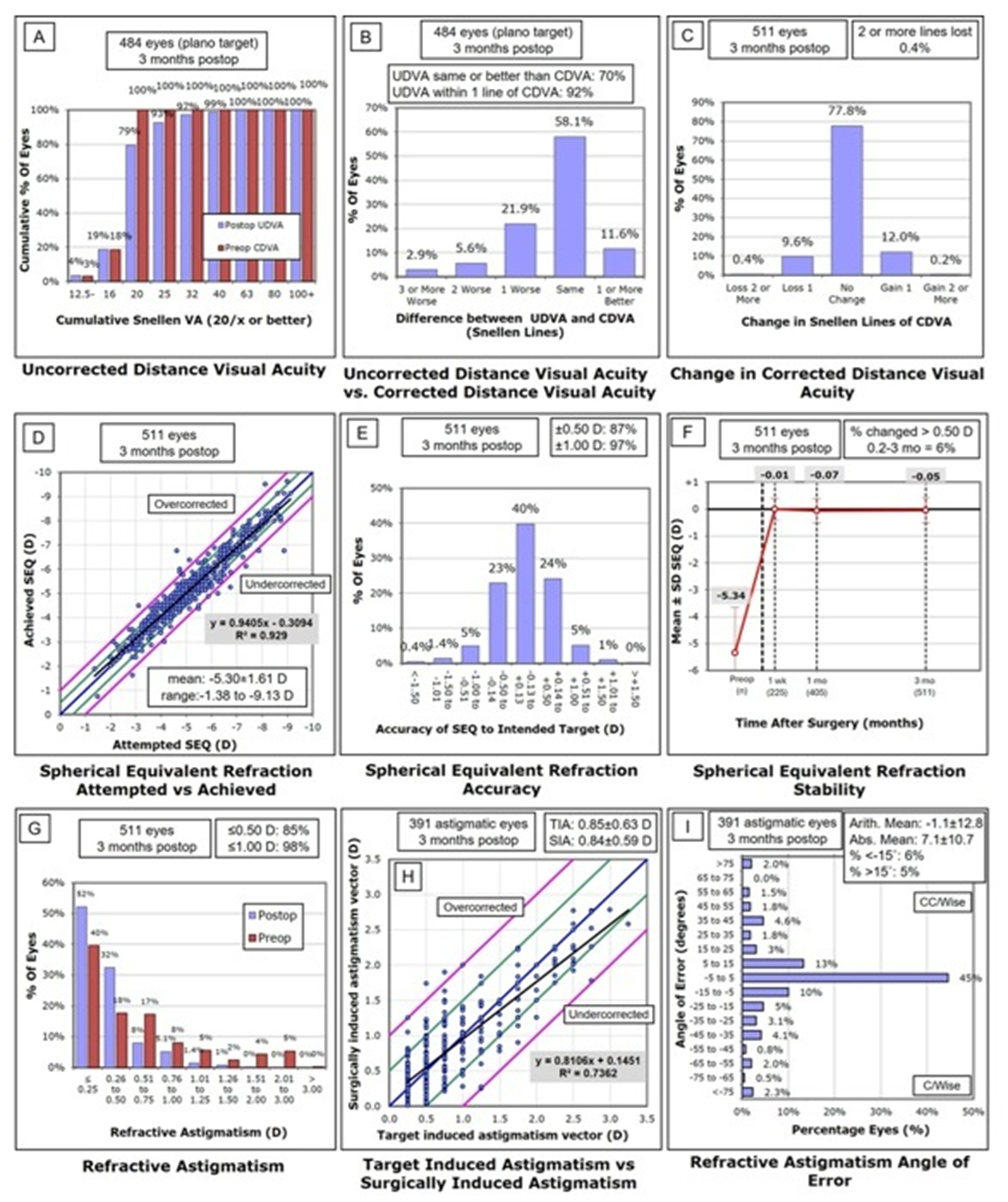
Results: Of 577 treated eyes, data were available at 3 months for 511 eyes (88.6% follow-up) and 12 months for 440 eyes (76.3% follow-up). Mean spherical equivalent (SEQ) improved from -5.35 ± 1.62 D (-9.63 to -1.38 D) to -0.04 ± 0.44 D (-1.88 to 1.88 D) (P < 0.001). Mean cylinder improved from -0.66 ± 0.66 D (-3.00 to 0.00 D) at baseline to -0.40 ± 0.32 D (-1.75 to 0.00 D) at 12 months (P < 0.001). Additionally, postoperative UDVA was 20/20 or better in 81% of eyes and 20/25 or better in 94% of eyes. Postoperative SEQ was within ±0.50 D in 85% of eyes and within ±1.00 D in 97% of eyes at 12 months. The SEQ remained stable across all postoperative visits, with a mean change of -0.03 ± 0.38 D from 3 to 12 months. There was a gain of one line of CDVA in 16% of eyes at 12 months, with no eyes losing two or more CDVA lines. Target-induced and surgically induced astigmatism were strongly correlated at both 3 and 12 months, with a mean undercorrection of 20% by one year (R² = 0.69).
Conclusions: KLEx demonstrates predictable and safe correction of myopia and myopic astigmatism over 12 months in a US cohort. Visual outcomes meet or exceed FDA benchmarks and are consistent with published literature, although a potential need for improved cylindrical correction remains.
- Abstract Viewed: 0 times
- Full Text PDF Downloaded: 0 times


