Sutureless-dehydrated amniotic membrane (Omnigen®) mounted on contact lens (OmniLenz®) in the treatment of small corneal perforations secondary to exposure keratitis in ICU patients
Medical hypothesis discovery and innovation in ophthalmology,
Vol. 14 No. 4 (2025),
17 December 2025
,
Page 194-203
https://doi.org/10.51329/mehdiophthal1532
Abstract
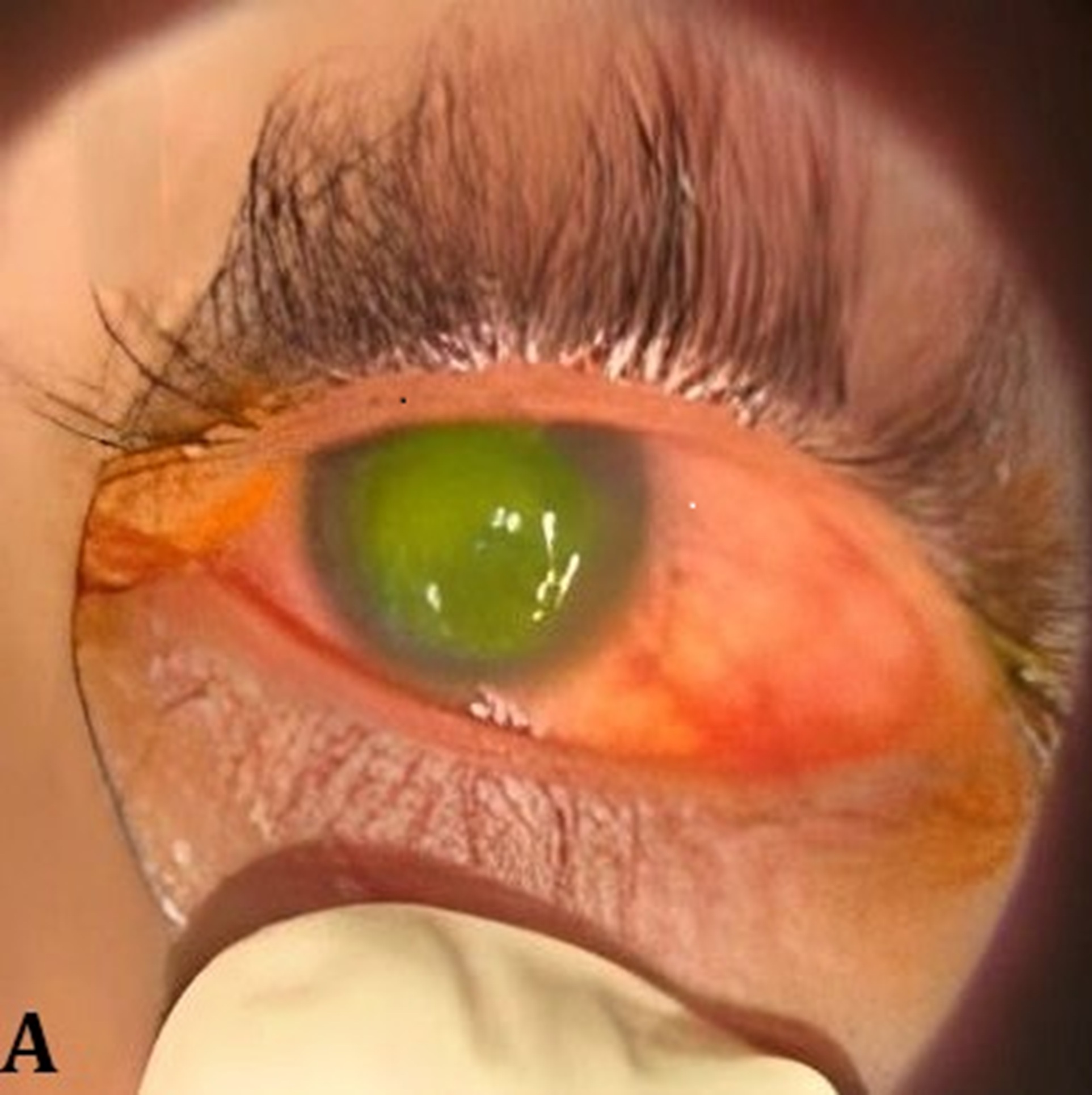
Background: Exposure keratopathy is a common ocular complication in patients admitted to the intensive care unit (ICU) and may progress from superficial epithelial breakdown to corneal perforation, a vision-threatening emergency requiring timely management. Conventional treatments often necessitate urgent surgery, which is challenging in critically ill individuals who are unsuitable for surgical intervention. OmniLenz®, a customized bandage contact lens pre-lined with vacuum-dried Omnigen® amniotic membrane, offers a practical, non-surgical, bedside alternative for managing small corneal perforations. This study evaluates its clinical outcomes in ICU patients with a small corneal perforation secondary to exposure keratitis.Methods: This prospective interventional case series included ICU patients with <1 mm corneal perforations secondary to exposure keratitis, recruited over a two-year interval. All patients underwent corneal scraping with culture and sensitivity testing, followed by targeted antimicrobial therapy. A dehydrated amniotic membrane (Omnigen®) was applied beneath a customized bandage contact lens (OmniLenz®) at the bedside under sterile conditions. Patients were examined daily using a portable slit-lamp and followed for one month. The primary outcome was perforation closure, defined by a negative Seidel test and anterior chamber reformation. Secondary outcomes included improvement in epithelial integrity, corneal infiltration, and ciliary injection.
Results: Five ICU patients, aged 18 to 70 years, with < 1 mm corneal perforations secondary to exposure keratitis were included. All eyes demonstrated rapid tectonic recovery following Omnigen®/OmniLenz® device application. Anterior chamber reformation and a negative Seidel test were achieved by day 7 in four patients and by day 10 in one patient. Complete perforation closure occurred in all cases. Marked improvement in keratitis was observed, with full epithelial defect healing and resolution of corneal infiltrates in every patient, followed by stable grade-3 stromal scarring. No neovascularization, device-related adverse events, or treatment complications occurred during the one-month follow-up.
Conclusions: Omnigen®/OmniLenz® device provides a safe, effective, and non-invasive bedside treatment for small corneal perforations secondary to exposure keratitis in critically ill ICU patients. Its use enabled consistent tectonic restoration, rapid perforation closure, and resolution of infection-associated corneal pathology without procedure-related complications. This approach offers a practical alternative to urgent surgical intervention in patients unsuitable for operative care and may serve as a valuable addition to corneal perforation management protocols. Further studies with larger cohorts are needed to evaluate its safety and efficacy in larger perforations and to determine long-term outcomes, including corneal scarring and visual acuity.
- Abstract Viewed: 0 times
- Full Text PDF Downloaded: 0 times


